
When planning an investment in a pulp egg tray production project, most investors naturally focus on the large forming machines or long metal drying tunnels. The mold itself is rarely the main topic of conversation, but it plays a critical role in the manufacturing process. As the tool that directly shapes the raw pulp, the mold is highly important because its design and quality directly affect your final product quality and production efficiency.
How Mold Performance Affects Production Output and Quality
Under the power of a vacuum system, the pulp slurry—which is 99% water and 1% fiber—is drawn into the egg tray forming machine. Excess water is immediately pulled away and removed through a water-vapor separation tank. As the water clears, the fibers bond together inside the mold to form the exact shape of the tray. The speed and quality of this process depend directly on how the mold is engineered.

How Drainage Holes Decide Product Quality
The size, spacing, and layout of the drainage holes on the mold surface determine how evenly the fibers accumulate. An optimized design ensures uniform water removal, giving the product a consistent thickness, smooth surface, and stable structure.
How Mold Alignment Affects Defect Rates
Efficiency also depends on mechanical precision. During production, the forming mold must align perfectly with the transfer mold. An alignment error of even a fraction of a millimeter can compress the damp fiber matrix incorrectly, causing micro-tears, warping, and high reject rates.
Choosing the Right Material: Plastic vs. Aluminum Molds
Selecting the proper mold material requires a balance between your upfront budget and your long-term production goals. Modern paper fiber molding relies on two primary materials, each serving a different stage of business growth.
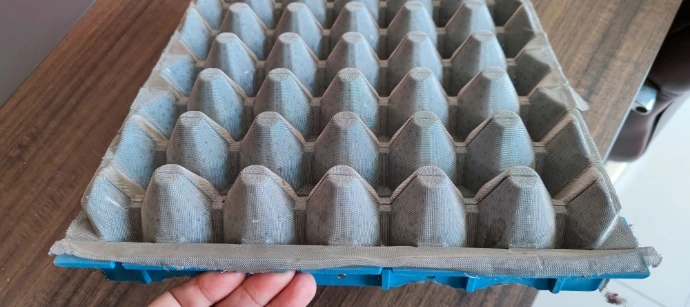
Plastic Molds
– 2-3 years lifespan
Plastic molds are an agile, cost-effective solution for specific production needs. They are highly practical for:
- Initial investment: Ideal for startup operations, seasonal packaging runs, or testing niche markets without heavy upfront capital.
- Rapid prototyping: Allows investors to quickly build, test, and validate new packaging designs before committing to mass production.
- Chemical resistance: High-density industrial plastics handle common pulp additives well, such as water-repellent or oil-proofing agents.
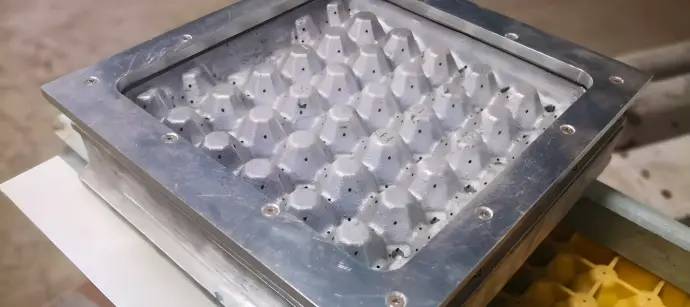
👍 Aluminum Molds
– 5-8 years lifespan
Aluminum alloys are the professional standard for continuous, automated production lines due to their superior physical traits:
- High thermal conductivity: Aluminum transfers heat instantly. During hot-pressing, it flash-evaporates water quickly, cutting cycle times by several seconds per press.
- Extreme durability: With high surface hardness, aluminum resists deformation under heavy hydraulic pressure, ensuring the millionth product looks exactly like the first.
- Lower total cost of ownership: Aluminum molds last for over a million cycles, reducing machine downtime, maintenance, and product reject rates.
Designing Molds for Different Products and Market Needs
To meet different packaging demands, a mold must be highly customizable. True flexibility means adjusting both the outer shape and the tray capacity to match specific market preferences and commercial standards.
Shape Customization for Different Trays


Egg Packaging
Customized trays and cartons for chicken eggs, as well as high-density nesting shapes for smaller quail eggs.
Fruit Trays
Shock-absorbing trays that fit round apples or tapered pears tightly, preventing bruising during shipping.
Coffee Cup Trays
Sturdy coffee cup carriers and multi-compartment beverage holders built with structural ribs to prevent tipping.
Nursery Trays
Heavy-duty, porous trays for automated greenhouses, featuring root-guidance slots for easy plant removal.
Pocket and Capacity Customization for Different Tray Sizes
Molds can be engineered to produce trays with different pocket configurations based on local market habits or shipping standards. For example, in egg tray production, the mold can be customized to form 15-pocket, 20-pocket, or the standard 30-pocket egg trays. This allows producers to quickly switch layouts and serve different retail or wholesale clients using the same production line.


Daily Maintenance: Keeping Molds Running at Peak Performance
Even the best-designed molds require consistent upkeep. Because tooling operates around constant water, abrasive fibers, and hydraulic pressure, regular care is necessary to keep production stable and efficient.
Routine Cleaning to Prevent Fiber Clogging
Over-extended production runs, pulp residues, and water scales gradually build up inside the tiny drainage holes and behind the wire mesh. If left uncleaned, this buildup blocks the vacuum airflow and slows down water removal. Implementing a scheduled cleaning routine—such as high-pressure washing or specialized baths—removes these residues, maintains peak drainage efficiency, and ensures a uniform product thickness.
Regular Inspection for Surface Wear
In high-volume manufacturing, constant mechanical friction will eventually cause surface wear. Setting up a preventative inspection plan allows operators to spot early signs of wear before product quality drops or parts warp. Finding these minor issues early keeps the molds aligned with their original design specifications.
How Mold Design Impacts Your Drying Energy Costs
Many investors do not realize that the design of a pulp molding mold directly affects their monthly energy bills. The forming stage is where water removal begins, and a well-engineered mold makes the downstream drying process much cheaper and faster.

Maximizing Wet-Pulp Dewatering Efficiency
When the mold is under vacuum, it needs to remove as much water as possible before the wet tray enters the drying tunnel. If the layout of the tray cavities allows the pulp to distribute evenly, the vacuum can pull water out consistently across the entire surface. This minimizes the wet weight of the product, meaning your drying line requires far less heat and fuel to evaporate the remaining moisture.
Improving Venting to Speed Up Steam Evaporation
Inside the metal dryer, heat must quickly penetrate the tray to turn trapped moisture into steam. If a mold’s internal venting paths or mesh support are poorly designed, they create dense spots in the pulp that act like a shield, blocking heat transfer. This forces you to slow down the entire conveyor belt and turn up the natural gas or electricity just to dry the centers of the trays.
Conclusion: Balancing Engineering and Materials for Long-Term Value
In conclusion, custom molds are the fundamental engine driving efficiency, aesthetics, and profitability in pulp molding operations. By choosing the right mold material for your production scale and leveraging precise geometric customization—from targeted hole counts to specialized agricultural shapes—factories can optimize dewatering speeds, lower drying costs, and deliver premium packaging.