
The global packaging world is changing fast. With plastic being banned in more and more countries, eco-friendly packaging is no longer just an option—it’s a must. For those looking to start a green business, making paper egg trays is a smart choice. It’s a low-risk project with steady demand and great room to grow.
Why Egg Trays are the Perfect Entry Point for Startups
In the investment world, simple usually means stable. Egg trays might not be high-tech, but they are a vital part of how the world gets its food.

High-Frequency Demand: A Stable Product for Every Market
Eggs are the most affordable protein on earth. Because eggs break easily, they must have protective packaging to survive the trip from the farm to the store. This creates a constant need for trays. Unlike fancy gift boxes, egg trays are used once and then recycled or composted, which means customers will keep coming back to you for more.
Functional Superiority: Why Paper is Better Than Plastic
The market is moving away from plastic, not just for the environment, but for better performance.
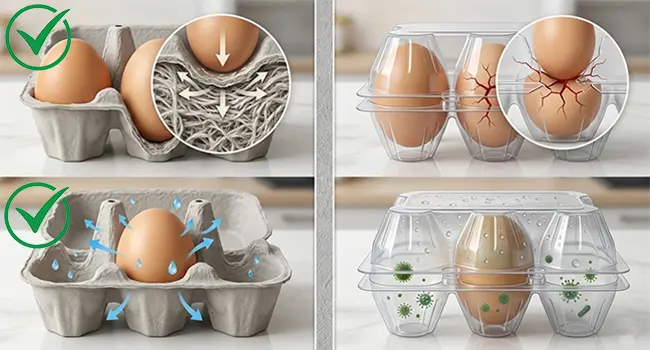
- Shock absorption: The fibrous structure of paper pulp acts as a natural cushion, protecting eggs far better than brittle plastic.
- Keep eggs fresh: Eggs actually need to breathe. Paper pulp is porous, allowing moisture to escape and preventing the growth of mold and bacteria—a critical advantage over non-porous plastic containers.

Production Versatility: Maximizing ROI with Modular Molds
A common misconception among beginners is that an egg tray machine can only make egg trays. In reality, the machine is a versatile molding platform. By simply changing the molds, a startup can pivot its entire production line within hours to produce:
- Fruit trays: For apples, melons, and pears.
- Coffee cup tray: High-demand items for urban takeaway markets.
- Nursery trays: Used by farms and gardens to grow young plants.
Low Entry Barriers: Localized Raw Materials and Cost Control
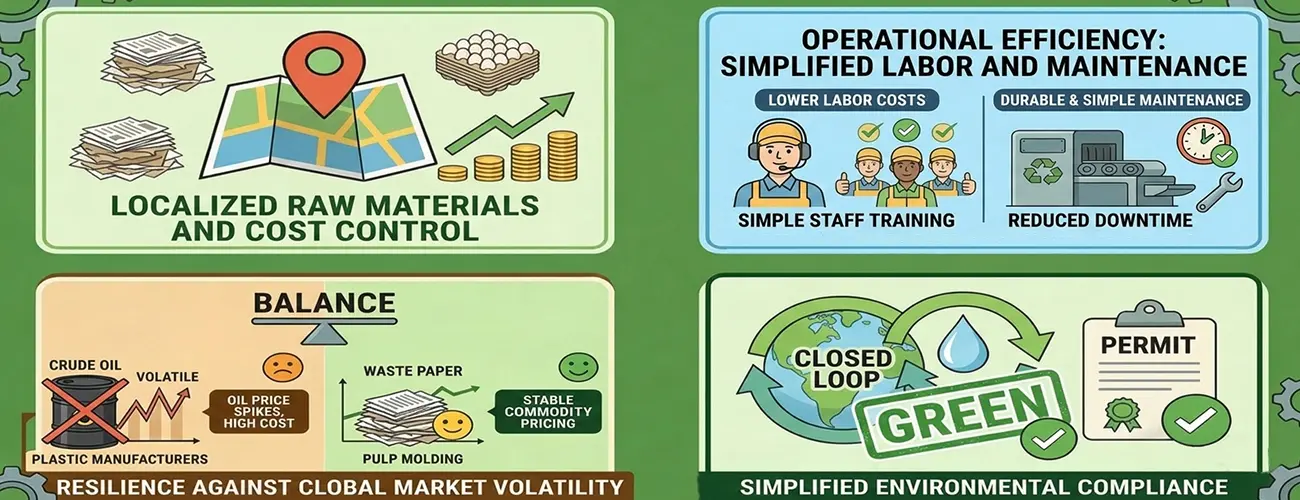
One of the biggest challenges for a new factory is getting raw materials. Pulp molding machine projects solve this problem by using local resources.
Turning Waste into Wealth: Using Local Recycled Paper
The primary raw material for egg trays is waste paper. This includes old corrugated cartons, old newspapers, office waste, and printing scraps. By turning low-cost local waste into high-demand products, investors can keep supply chains simple and maintain much higher profit margins.
Operational Efficiency: Simplified Labor and Maintenance
The egg tray production process is straightforward and does not require a large team of highly specialized engineers. For an investor, this means lower labor costs and easier staff training. The machinery is designed for durability and simple maintenance, reducing the risk of expensive downtime and making it an ideal first project for industrial startups.
Resilience Against Global Market Volatility
Plastic manufacturers are at the mercy of crude oil prices. When oil prices spike, the cost of plastic pellets skyrockets. In contrast, waste paper is a locally traded commodity with relatively stable pricing. This price stability allows for more predictable profit margins and easier long-term financial planning.
Simplified Environmental Compliance
Starting a plastic factory is often difficult due to toxic gases and strict environmental checks (EIA). However, pulp molding is a clean, physical process. There are no harmful emissions, and the water is reused in a closed loop. For an investor, this “green” profile means faster government permits and better access to eco-subsidies.
Technical Configuration: Building a High-Performance Line for Egg Trays
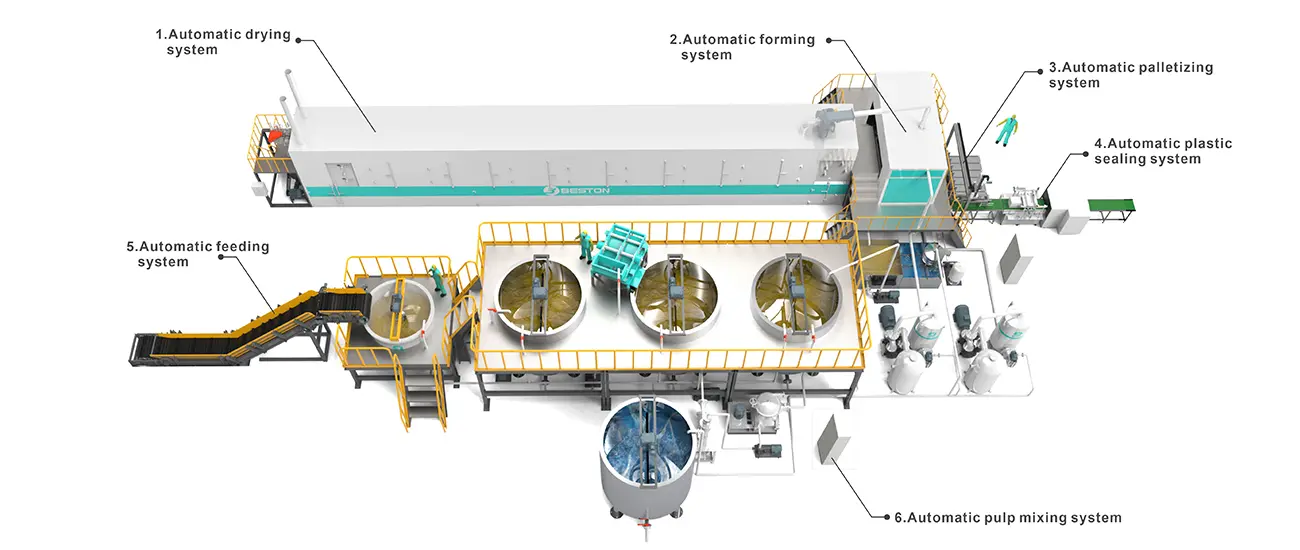
For an investor, a factory should be simple to manage and highly efficient. A modern egg tray production line consists of three core systems, with optional upgrades available to achieve full automation from start to finish.
Automated Pulping: Quality Control at the Source
Instead of manual mixing, an automated pulping system breaks down waste paper and balances the water-to-fiber ratio perfectly. For an investor, this ensures the pulp consistency is handled automatically.
Precision Forming: Consistency in Every Egg Tray
The forming machine uses high-precision molds to press pulp into shape. By moving away from manual handling and using an integrated forming system, an investor reduces the risk of human error. This automation ensures that every single tray has the exact same dimensions and weight.
Metal Drying: Maximum Efficiency in Minimum Space
Removing water is the most critical stage. Multi-layer metal drying system uses a high-efficiency heat recovery design, significantly cutting down on fuel or electricity costs. This is the most reliable way to maintain fast production speeds and a small factory footprint, regardless of outdoor weather conditions.
Smart Upgrades: Modular Systems for Future Growth
Beyond the core line, investors can add optional systems to further reduce labor costs. This includes automatic feeding for raw materials, auto-stacking for finished trays, and shrink-wrapping for professional packaging. These modular upgrades allow a startup to begin with a basic setup and scale up to a fully unmanned operation as the business grows.
Financial Insight: ROI and Long-Term Profitability
Ultimately, the decision to start a factory comes down to the numbers. The pulp molding business is characterized by high volume and steady margins.
The Value-Added Model: Transforming Bulk Waste into Premium Units
Profitability in this industry stems from the massive price gap between raw materials and finished goods. Investors purchase low-value waste paper by the ton and convert it into high-value packaging sold by the piece. As essential consumables with a high turnover rate, egg trays ensure a rapid return on investment (ROI) through consistent, high-volume sales and steady cash flow.
Reliable Cash Flow: The Power of Recurring Demand
Unlike one-time luxury purchases, egg trays are a staple of the food logistics chain. Since trays are typically recycled or disposed of after use, end-users—such as large-scale poultry farms and supermarkets—require a constant supply. For an investor, this creates a predictable, recurring revenue stream. This steady cash flow ensures first-year stability and provides the capital needed to expand production in the future.
Real Project ROI Analysis of Egg Tray Making Machine
| Instruction | According to the market data of European market, the estimated ROI report, the varous expenses are as follows: | |||||||
| Fixed Investment Cost | Item | Details | Unit | Unit Price/USD | Quantity | Amount/USD | Total Amount | Remark |
| Equipment | BTF5-8 | Set | 150, 500.00 | 1.00 | 150, 500.00 | |||
| Transportation | From China to Destination Port | Set | 44, 000.00 | 1.00 | 44, 000.00 | |||
| From Port to Site | Set | 1, 600.00 | 1.00 | 1, 600.00 | ||||
| Custom Tax | 15% | Set | 29, 175.00 | 1.00 | 2, 9175.00 | |||
| Installation | Beston Technican's Salary | Day | 350.00 | 15.00 | 5, 250.00 | |||
| Round-trip Air Tickets | Ea | 2, 500.00 | 2.00 | 5, 000.00 | ||||
| Visa | Ea | 350.00 | 1.00 | 350.00 | ||||
| Local Welder | Day | 120.00 | 40.00 | 4, 800.00 | ||||
| Local Plumber | Day | 120.00 | 40.00 | 4, 800.00 | ||||
| Local Labor | Day | 108.00 | 60.00 | 6, 480.00 | ||||
| Crane Forklift | Day | 160.00 | 10.00 | 1, 600.00 | ||||
| Materials | Installation Materials Ready | Set | 2, 000.00 | 0.00 | 2, 000.00 | Foundation, pipe, etc. | ||
| License | / | Ea | 0.00 | 0.00 | 0.00 | Environmental, firefighting, etc. | ||
| Workshop | 1000.00 | ㎡ | 380.00 | 1000.00 | 38, 0000.00 | Rent in rural area | ||
| US$: 635,555.00 | ||||||||
| Opretating Cost | Raw Materials | Waste Paper | Ton | 0.00 | 9.56 | 0.00 | 22.5 hours per day working | |
| Water | / | m³ | 0.32 | 28.69 | 9.18 | |||
| Electricity | / | KWH | 0.08 | 2787.75 | 209.08 | 22.5H | ||
| Fuel | Natural Gas | m³ | 0.37 | 1485.00 | 549.45 | |||
| Labor | / | People | 108.00 | 4.00 | 432.00 | |||
| Maintenance | / | Day | 5.00 | 1.00 | 5.00 | |||
| Depreciation | 8 Years | Day | 264.81 | 1.00 | 264.81 | |||
| Tax | 5% | 0.00 | ||||||
| US$: 1, 469.53 | ||||||||
| End Product Price | Egg Trays | 5000 pieces per hour | Pieces | 0.05 | 112, 50.00 | 5, 625.00 | ||
| Subsidy | / | Ton | 0.00 | 0.00 | 0.00 | |||
| US$: 5, 625.00 | ||||||||
| Daily Income | US$: 4, 155.47 | |||||||
| Monthly Income | Working Day | Day | 25.00 | US$: 103, 886.83 | ||||
| Yearly Income | Working Day | Day | 300.00 | US$: 1, 246, 642.01 | ||||
Conclusion: Taking the First Step with the Right Partner
Starting a pulp molding factory is an accessible, profitable, and noble venture. It solves the problem of waste paper, supports the local agricultural industry, and provides the market with a necessary green product. We invite you to contact us today for a customized egg tray production solution tailored to your specific market needs and investment goals.