
Eggs have long been an essential part of people’s daily diets, and as consumption continues to rise, so does the demand for effective packaging solutions. Egg trays and cartons play a vital role in ensuring eggs reach consumers safely, protecting them from damage while maintaining hygiene. This article explores the role of pulp molded egg trays, structural market trends, and operational challenges within the global egg tray industry.
Functional Importance of Pulp Molded Egg Trays

Operational Support Across the Egg Supply Chain
Pulp molded egg trays play a foundational role in the global egg industry by acting as a critical interface between production, logistics, and market distribution. At an operational level, they provide structural protection for fragile eggs, enabling efficient handling, stacking, and transportation across increasingly complex supply chains.
Economic Value in High-Volume Egg Distribution
From an economic perspective, egg trays help control breakage rates and logistics costs, directly influencing profitability for producers and distributors operating at high volumes and thin margins. Their standardized form also supports automation in grading and packing facilities, improving overall system efficiency.
Contribution to Sustainability and Regulatory Compliance
Equally important, pulp molded egg trays support industry sustainability goals. Manufactured mainly from recycled paper and fully recyclable, they meet regulatory requirements and market preferences for fiber-based packaging, reinforcing their role as long-term infrastructure within the global egg industry.
From Poultry Farm to Consumer: Egg Packaging and Logistics
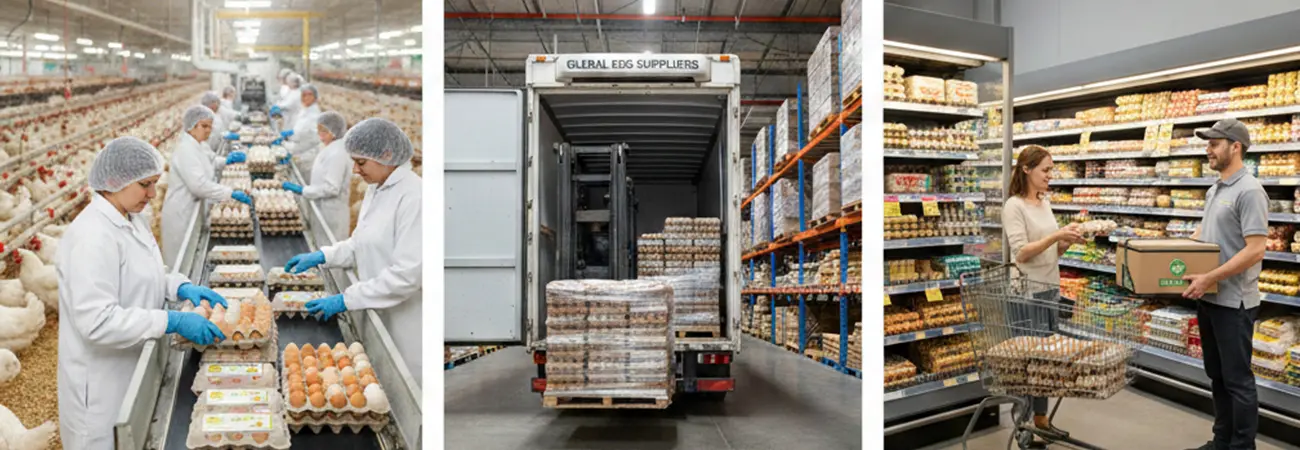
From Farm to Consumer
Eggs pass through a complex supply chain before reaching consumers. The process begins at poultry farms, where eggs are collected and sorted based on size and quality. These eggs then move to grading and packing facilities, where they are carefully inspected and placed into trays or cartons designed to minimize breakage.
Wholesale Distribution
Once packed, eggs are transported to wholesalers, who supply supermarkets, local markets, and restaurants. During this stage, packaging must withstand long-distance transportation and stacking in storage, ensuring that eggs remain intact.
Retail and Consumer Delivery
Retailers receive eggs and display them for sale, often in consumer-friendly cartons that offer both protection and convenience. For eggs sold online or through delivery services, additional protective measures may be added to prevent damage during shipping.
Structural Drivers Behind Rising Egg Tray Demand
The demand for egg trays has grown not only in volume but also in complexity. Several structural factors are reshaping how egg packaging is specified and produced.

Growth in Egg Production Volumes
Global egg production has increased steadily over the past decade, driven by population growth and rising protein demand. Higher output naturally translates into higher packaging consumption. However, scale introduces sensitivity: a marginal reduction in breakage rates can represent substantial economic savings when millions of eggs are handled daily.
Expansion of Distribution Radius
Egg distribution is no longer limited to short-distance regional markets. Improvements in cold chain logistics and transport infrastructure have extended delivery distances. Longer transport routes increase exposure to vibration and stacking pressure, raising the performance requirements for egg trays.
Automation and Standardization
Modern grading and packing facilities increasingly rely on automated systems. These systems demand egg trays with consistent dimensions, stable wall thickness, and predictable mechanical strength. Variability that was once tolerated in manual operations now leads to operational friction.
Transition Toward Fiber-Based Packaging
Environmental regulations and retailer sustainability commitments are accelerating the shift away from plastic packaging. Pulp molded trays, made primarily from recycled paper, align with circular economy principles and are widely accepted in both domestic and export markets.
Global Market Overview of Pulp Molded Egg Trays
The pulp molded egg tray segment is a major part of the global egg pack