Fresh eggs break easily, and every cracked egg means lost profit for producers. That is why the global market relies on the molded paper egg tray. It feels light and soft, weighing merely 80 grams, yet it successfully protects eggs under heavy stacked loads and bumpy roads. How can a simple paper tray be so incredibly strong? Read on to find out.
Smart Geometry: How Shape Distributes Weight
The primary secret to an egg tray’s strength is its 3D geometry. Flat paper bends under minor pressure, but molding it into specific shapes dramatically changes how it handles physical loads.
Arches and Cones
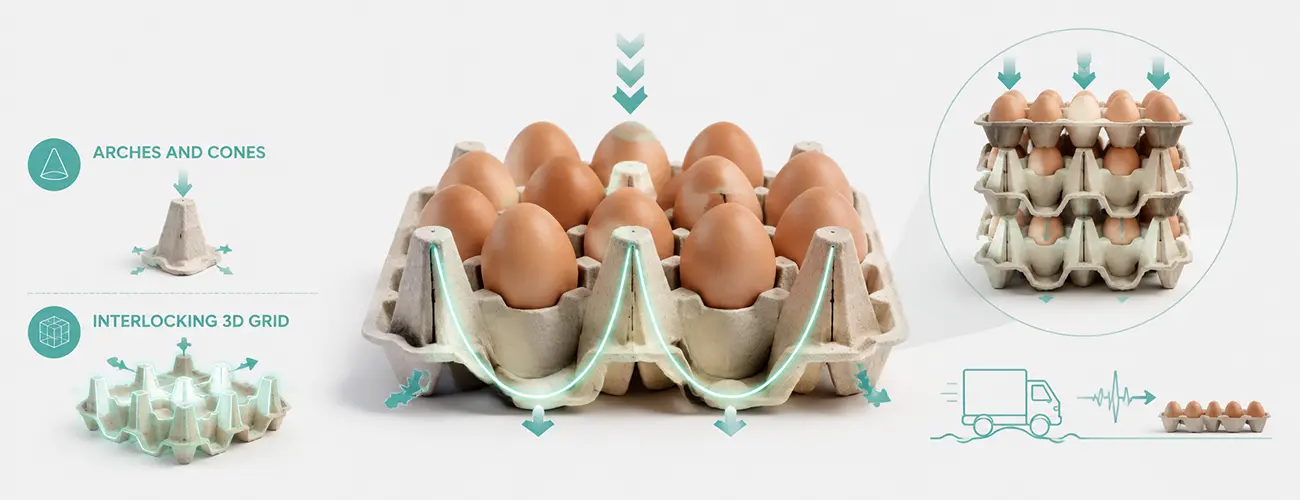
Look closely at an egg tray, and you will notice raised, cone-like pillars separating each cell. These are called truncated cones. In structural engineering, an arch or cone is ideal for bearing weight. When egg boxes are stacked high, the downward load never touches the eggs. Instead, the force lands on top of these paper cones. The sloped walls immediately redirect the vertical pressure outward and downward toward the base. By spreading stress across a wider area, the tray supports heavy stacked loads without buckling.
The Interlocking 3D Grid
An egg tray is not a collection of separate pockets, but a continuous 3D network. Raised ribs and supporting bridges tightly connect every cone and pocket together into a single structure. This interconnected design is key to surviving rough logistics. When a delivery truck hits a bump, the sudden shock wave does not impact a single egg pocket. Instead, the entire grid absorbs the physical impact and disperses the energy horizontally across the tray. This collective flexibility cushions the eggs and prevents localized breakage during transit.
Raw Materials & Microscopic Strength: The Power of Recycled Fibers
While geometry provides the blueprint for strength, the raw material gives the egg tray its physical toughness and resilience.
High-Quality Recycled Paper Raw Materials
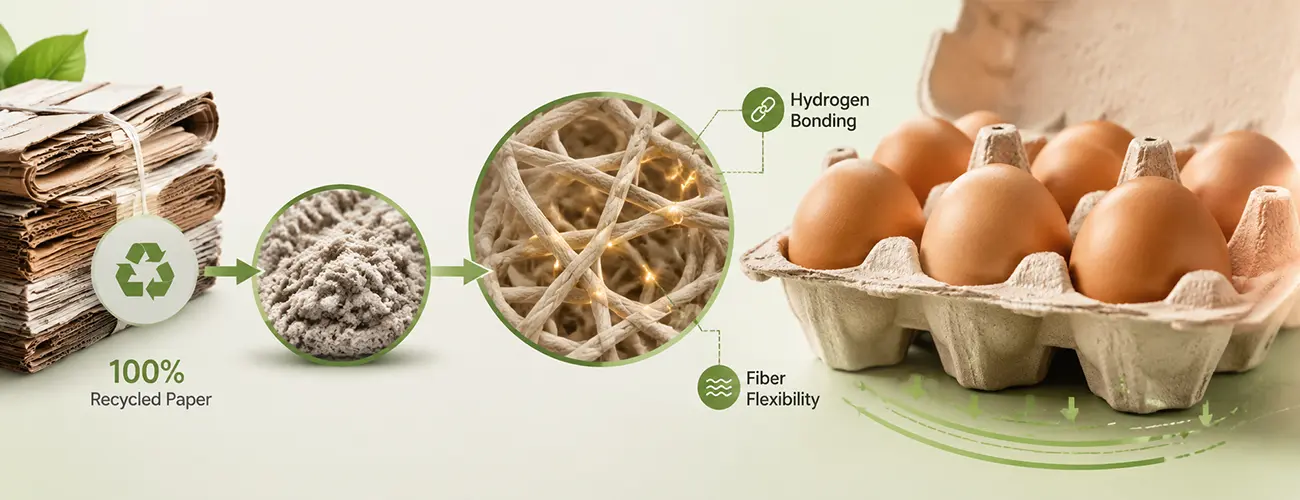
Most paper egg trays are produced from 100% recycled paper, particularly old corrugated cartons and newsprint. These materials are naturally rich in long cellulose fibers. When processed in a hydrapulper, the paper breaks down into millions of individual threads. Using long-fiber raw materials provides a strong, mesh-like physical foundation, giving the egg tray its fundamental structural integrity before molding.
Microscopic Hydrogen Bonding & Fiber Flexibility
As moisture evaporates during the drying process, a key microscopic reaction occurs: hydrogen bonding. Molecules on the surface of the cellulose fibers lock together tightly, acting like a natural glue. This molecular network creates an ideal balance: it gives the tray high rigidity to resist heavy crushing, while maintaining enough flexibility to absorb sudden transit shocks without cracking like plastic.
The Core Engine: How Pulp Molding Equipment Guarantees Tray Quality
Great geometry and quality raw materials provide the potential for a strong egg tray, but an advanced egg tray making machine turns that potential into reality. Precision equipment directly dictates whether an egg tray is tough or soft and prone to breaking.
Uniform Pulp Refining & Consistency
The strength of a paper egg tray begins in the pulping system. The hydrapulper mixes waste paper with water to create a smooth, homogeneous pulp slurry. If the pulp contains clumps or uneven fiber concentrations, the resulting paper tray structure will suffer from structural defects. Modern pulping systems maintain a precise, automated water-to-fiber ratio, ensuring that every batch of pulp provides a consistent foundation before entering the molding stage.
High-Precision Vacuum Forming Technology
The forming machine is the functional core of the production line. Precision CNC molds submerge into the pulp vat, where regulated vacuum suction pulls wet cellulose fibers onto the mold screen. If vacuum distribution is unbalanced, paper pulp settles unevenly, leaving thin spots along the cone walls. Advanced molding machines use optimized vacuum air pathways to guarantee uniform wall thickness across every cone, rib, and corner of the tray, eliminating localized weak points.
Controlled Multi-Stage Drying Systems
Upon exiting the forming phase, wet egg trays contain roughly 65% to 70% moisture and must pass through a specialized drying tunnel. Rapid drying under extreme heat causes outer paper layers to shrink faster than the inner core, resulting in warped, brittle packaging. Modern multi-layer metal drying tunnels carefully control temperature and airflow, removing moist